He that writes to himself writes to an eternal public. -Emerson

Sunday, November 29, 2020

Roadtrip: Death Valley

What's safer under the circumstances? Hang out for a week of no school, with the kids mixing promiscuously with their peers, or isolate in the enormous empty expanses of Death Valley? We made the right call...

Shots above include the Mojave airplane boneyard, the Panamint Valley, the Badwater Basin, a Ford Expedition, a truck on fire (not the Ford Expedition), Tatooine, our Thanksgiving breakfast, and the Mobius Arch.


Sunday, October 18, 2020

Voting, 2020

Choices, choices....

When I posted on this topic a lifetime ago in 2016, I made two predictions: that Trump would not be elected (wrong), and that he would be a disaster from a climate point of view if he were (too, too right). Facing the 2020 election, I repeat these assertions, though I would change one thing: Trump has shown himself not to be an undirected force where the climate is concerned, but an active and highly successful agent in retarding or even reversing progress on the environment. The situation in 2016 was already dire, the lost years may have made it irretrievably so. The only positive note is that awareness of the climate catastrophe has grown--being unable to breathe focuses the attention wonderfully.

Voting for Biden/Harris requires no thought (and if you think otherwise, please do reach out to me), but there's more to be decided than just that. Our House Rep is up for reelection (yes, I'll take the Dem over the Republican, who lists his occupation as "Cashier," though honestly I don't know what I'd do if the situation were reversed), as is our state assemblyman (or will we vote for an assemblywoman?). But mostly what's at stake here is control of the schools and of the town (give Chance a chance!): local politics, thus, so not of interest to my mostly non-local readership.

That's all I will say this time 'round about voting for people. But California has a proposition system, so I need to vote on ideas, too. Figuring that out is time-consuming: it's easy enough to react to a proposal, but propositions as stated on the ballot may be very different from those same propositions in effect. Research is required, so research I did, spending many an hour (OK, maybe two) inside the Lincoln/Douglas debate for each one. In the end (and I did not check this until the end), my preferences tallied exactly with those of the California Democratic party's. Except for one thing: they offer no recommendation for Prop 24 and I do.

Prop 24 concerns itself with an issue near to my heart: consumer privacy laws. This is an especially important matter here in California, which, in the absence of federal leadership, is the strongest US force supporting privacy rights. Does 24 move us closer to a new regime in which each individual's data is recognized as uniquely sensitive, uniquely valuable, and uniquely deserving of the protections of law? The answer is yes and no, which is why neither the Dems nor even that most opinionated of online organizations, the EFF, support or oppose it. So why do I urge you, my probably non-eligible reader, to vote NO on 24? Three reasons:

  1. The single most impactful change we could make to the existing California Consumer Protection Act is to make opt out the default selection for data collection permissions. Prop 24 doesn't change the current standard, which means that most of us will continue to be opted in, and the rest of us will eventually give up on opting out as data collection schemes find new ways to make it increasingly laborious to do so.
  2. Prop 24 would end the CCPA's protection of biometric data. That would be a terrible mistake: in the age of facial recognition and Fitbits, biometric data needs more protections and a broader definition of what is included in that rubric, not less.
  3. Prop 24 does not allow consumers to sue businesses for privacy violations, instead inviting a to-be data protection agency to guard our interests. But the struggles of similar agencies in Europe do not give me a lot of hope for this approach, or not, at any rate, as a standalone means of enforcement. We need to be able to sue the bastards because only then will they behave. Maybe.

One final comment: your vote doesn't count unless it's counted. Voting fraud by individuals is negligible, but I'm not as sanguine about vote counting. No, this is not the start of another conspiracy theory, but rather a recognition that there's a lot of work to be done tallying votes, that humans make mistakes, and that it's an easy enough thing to check the status of your ballot, so do so. Then, come November, check the results!

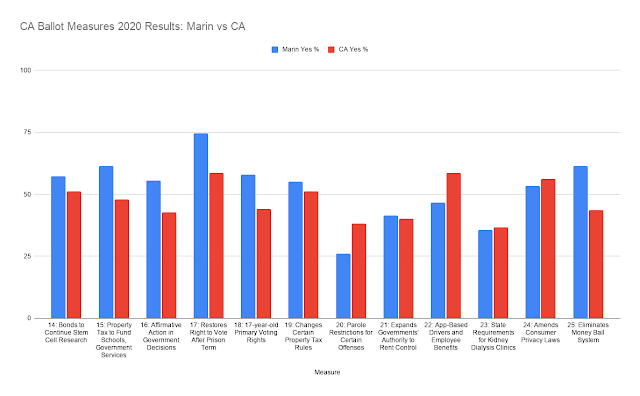
UPDATE: How'd it turn out? Well, I got my ballot in...

But not everything went as I wished it:

California is my home, but even more so, Marin.

Saturday, September 12, 2020

Orange skies

Air quality, 12 September 2020

I have blogged before about fires here in California, and the destruction they leave behind them. Back then--October 2017--we played a game of cat-and-mouse with the smoke, departing for Yosemite and then coming back once offshore winds had moved the pollution away from our home. What is happening now is on a totally different scale. To escape the smoke caused by the current fires near and far we would have to get on an airplane and fly to the other side of the Rocky Mountains, a distance of about a thousand miles. To be really sure, we would have to go even farther: smoke from these fires has reached Nebraska, five hundred miles further to the East. (For our European readers, that is further than the distance from Amsterdam to Moscow.)

Back here in California, the smoke is so thick that for the better part of a week we haven't seen the sun, except once or twice, as a faint pink ball. We wake each day to a world without shadows, dusted with ash that's fallen from a gray sky. Except for Wednesday, when the sky was orange. "What fresh hell?!" texted a friend of mine from the city, gazing out at this view...

The view from Dolores Park

The smoke that caused this apocalyptic effect came down from Oregon, where currently more than a tenth of the entire state's population is under evacuation notice, if they haven't already fled. Oregon, which is known for its lush greenery, is also on fire, with many towns utterly destroyed and the city of Portland itself threatened.

Still, the smoke can mostly be avoided, at least by those of us privileged to work in our own homes, serviced by grocery delivery, and with plenty of HEPA filters around and about. But what about the fires themselves, do they pose any real threat? At the moment, they do not, but things this time do feel even more...personal. For one thing, the Woodward Fire, the source of the smoke I mentioned in my last post, is less than 20 miles from our home, the nearest such event since we've lived here. Sparked by lightning, it has been burning since August 18th, and isn't expected to be fully contained until September 12th. That fire grew rapidly, and scarily, because it is in deep woods difficult to access, and because with so many fires burning elsewhere it couldn't be properly attended to until teams were brought in from Montana.

Fire fighting encampment in the next valley over

That fire is under control, but there are much larger fires raging totally out of control elsewhere in the state. This photo is one of the more terrifying images associated with the current conflagrations:

View from the Bidwell Bar Bridge over Lake Berryessa, 9 September 2020

This is nowhere near us, but we did drive over this bridge on our way back from camping just a few weeks ago. Indeed, Gid and I got out to walk across it:

Same bridge, less than a month ago

Those trees are gone, the road is closed, and the nearby town of Berry Creek, which I noted as we passed through because even from the road it was obvious that the creek was indeed full of berries, has been destroyed.

In truth, it is only a matter of time before fire swings through our neighborhood. We live with go-bags packed, escape routes noted...we are fire safe, but not fire proof. So why stay, you ask? Because, in truth, it is only a matter of time before climate disaster finds all of us, everywhere, and here in California we are at least learning the true scope of that disaster while there is still time to prepare for it.

Sunday, August 23, 2020

Disaster living

Happy place

"Oh, 2020," the Internet moans, "What else do you have in store for us?" Writing from California--blanketed by smoke, with more fire-starting thunderstorms on the way--and facing a third of the year still to come, it is hard to keep a brave face. And more bad news: the epic Trumpfoolery aside, 2020 will be followed by worse years still. The hallmark of climate change is concurrent disasters, after all.

Pandemic living is not the new forever, but we have to accept that disaster living is. I do not expect ever again to enjoy long periods in which the world around me seems calm and well-adjusted. But I do want my internal world to be calm and well-adjusted just as often as it can be. That's going to take work and preparation. Some things I tell myself:

  • Focus on making progress, not on being done. Because we are--I'll write about the Barn, soon--but will never be.
  • Meet uncertainty with diversity. You can't prepare for everything, but if you're well prepared for at least a few scenarios--fire, flood, earthquakes--then when something new (a pandemic, say) takes you by surprise you'll probably have at least a few N95s on hand.
  • Put yourself out there. Not literally--stay at home, except maybe if you're going camping--but visualize the world you no longer encounter. Those friends are still there, those places are still there, those problems are still there, and there are still ways to interact with and to help all of them.
  •  Give and ask. Friends of ours, aware of our lack of air conditioning and of the situation outside our window...

...let us borrow not just one but two air purifiers. Saved the day (or possibly the week), and reinforced existing mutuality. We are none of us going to get through this alone, nor will we have to.